What Is Dual Standby on Dual SIM Phones? DSDS Explained for 2026
Updated September 2026 · DualSIMCardPhone
What Is Dual Standby on Dual SIM Phones? DSDS Explained for 2026
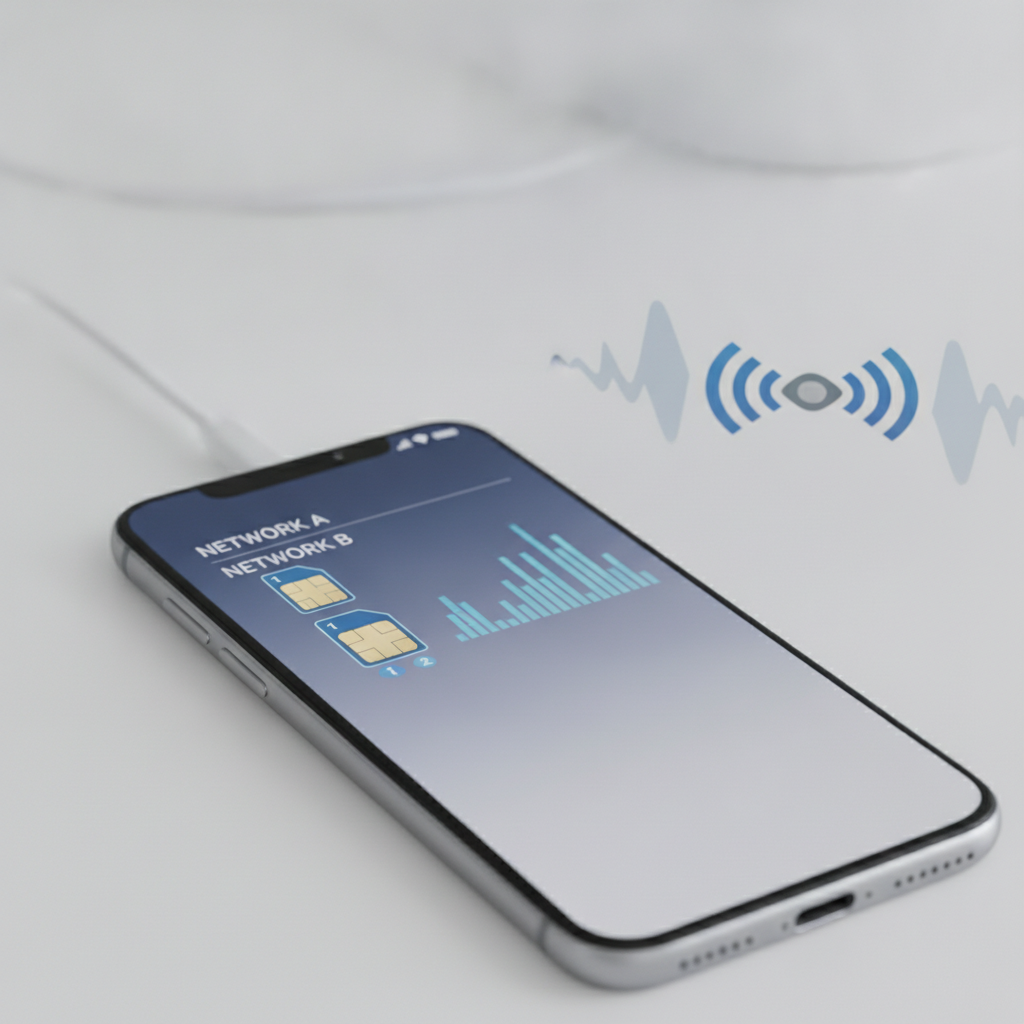

Dual standby — officially Dual SIM Dual Standby (DSDS) — means both SIMs in your phone are registered on their networks at the same time, and either line can ring or receive texts while the phone sits idle. The catch is in the name: both SIMs stand by, but only one can be active. Because the two lines share a single modem radio, the moment you answer a call on SIM 1, SIM 2 effectively goes off the air until that call ends.
That is how almost every dual-SIM phone sold in 2026 behaves — the Galaxy S26 series, the iPhone 17 line, the Pixel 11 — whether it uses two physical SIMs, one physical SIM plus an eSIM, or two eSIM profiles.
Chester Takau · DualSIMCardPhone
Chester Takau is an independent reviewer of dual-SIM and eSIM technology, testing setups from the Pacific where connectivity choices really matter.
How dual standby actually works
A dual standby phone has two SIM identities but one radio. At idle, the modem time-slices between them: it registers SIM 1 on its carrier, registers SIM 2 on its carrier, then listens for incoming-call "paging" signals on both, alternating in fractions of a second. To you, it looks like both lines are simply on. Under the hood, the phone really is running two networks on one phone at once — it just can't talk on both at the same moment.
Mobile data works the same way. Only the SIM you nominate as your data line carries traffic; the other stays registered for calls and texts. When a voice call starts on either line, the radio commits to it fully. The other SIM's paging channel goes unanswered, and its carrier marks the line unreachable for the length of the call.
If you'd rather see the mechanics than read them, this explainer walks through how dual-SIM phones juggle two lines on shared hardware:
Dual standby vs dual active vs dual VoLTE: what's the actual difference?
Three acronyms get blurred together in spec sheets, and most explainers stop at "the other line goes dark." Here is the comparison as it stands in 2026, mapped to where each mode actually ships:
| Mode | Radios | During a call on SIM 1 | Where you find it in 2026 |
|---|---|---|---|
| DSDS (Dual SIM Dual Standby) | One, shared | SIM 2 is unreachable; callers hit voicemail or an "out of coverage" message | Default on virtually all dual-SIM phones: Galaxy S26, iPhone 17, Pixel 11 |
| DSDV (Dual SIM Dual VoLTE) | One, shared | Same standby behaviour, but both lines stay camped on 4G/5G for fast call setup and clean data | Most 2026 flagships, where both carriers support VoLTE |
| DSDA (Dual SIM Dual Active) | Two, independent | SIM 2 still rings; you can hold one call and answer the other | Rare. The Pixel 11's modem supports it in hardware, but Google ships it disabled |
The short version: DSDS is the standard, DSDV is a refinement of it that keeps both lines on modern networks, and DSDA is the genuine "both lines always live" mode that almost no current phone actually enables. For a deeper technical rundown of standby behaviour in current hardware, 5Gstore's updated DSDS guide (July 2026) is one of the few that covers routers as well as phones, and SmartPhoneDomain's dual-active vs dual-standby breakdown covers the radio side. One older, weaker mode completes the picture: Dual SIM Single Standby (DSSS), where only one SIM is registered on its network at a time and the other stays unreachable until you manually switch — the configuration to watch for in legacy and ultra-budget devices, where "dual SIM" barely earns the name.
Why doesn't my second SIM ring while I'm on a call with the first one?
Because the radio is busy, and the network knows it. When someone dials your SIM 2 number mid-call, their carrier sees the line as unreachable. What happens next depends on the carrier: the caller may hear an "out of coverage area" message, get sent to your voicemail if unreachable-forwarding is set up, or just get dropped.
The part that surprises people is the notification gap. On most dual standby phones, that missed call on SIM 2 produces no missed-call notification at all — the phone never saw the call, so there is nothing to log. You find out only if the caller leaves a voicemail or texts you. This is the single most common complaint in dual-SIM forums, and it's a design consequence of DSDS, not a defect in your unit. One caveat in the other direction: a second line that misbehaves even when you're not on a call is not standby behavior. Google's official dual-SIM guidance calls out "Voice unavailable" or "Voice interruptions" notifications for SIM and network combinations that don't work well together — that's an actual connectivity problem to raise with your carrier, not a design limit to accept.
There is a partial fix. Many Android phones (Samsung calls it out in Settings → SIM manager → Dual SIM always on) offer an "always on" toggle. It doesn't add a second radio — it sets up carrier-level call forwarding between your two numbers, so a call to the busy SIM gets forwarded to the active one. For it to work, both carriers must support call forwarding and call waiting, and some charge for forwarded minutes. Users across multiple device generations report the toggle is unreliable even when both carriers claim support, so treat it as a mitigation, not a guarantee. The dependable fallback is making sure each line forwards unanswered/unreachable calls to its own voicemail.
Why do OTP texts arrive late — or not at all — on my second line?
SMS is store-and-forward, so in theory a text sent to SIM 2 while you're on a SIM 1 call just queues at the network and lands when the call ends. That part usually works. The delayed-batch problem people hit with banking OTPs and 2FA codes has a different cause: registration glitches. If the second line drops its network registration (weak band, a carrier settings hiccup, a modem firmware quirk), messages pile up at the SMSC and arrive in a clump hours later — or expire, in the case of short-lived OTPs.
Practical mitigations: put the line that receives your 2FA codes on the carrier with the strongest coverage where you live, keep both lines on VoLTE so registrations stay clean, and if a line goes silent, toggle it off and on in SIM manager (or cycle airplane mode) to force a fresh registration. If delays persist, ask the carrier to re-provision the SIM — stale provisioning is a frequent culprit.
Can I use dual standby with one physical SIM and one eSIM?
Yes — in 2026 that's the default arrangement rather than the exception. The Galaxy S26 series and iPhone 17 line standardize on one physical SIM plus eSIM, or dual-eSIM, in a DSDS configuration. Regional differences persist: US iPhone 17 units are eSIM-only, while EU and China models keep a physical tray, per Apple's dual-SIM support documentation.
On Android phones with two nano-SIM positions, watch for the tray type. Many models use a hybrid SIM slot, where the second position is shared with a microSD card — you pick a second line or extra storage, not both. That choice doesn't change the standby behaviour, but it changes what you can physically install.
A newer wrinkle: 2026 flagships increasingly support "eSIM stacking" — keeping multiple travel eSIM profiles active alongside a home line — where 2024–2025 devices typically allowed one physical SIM plus one or two active eSIM profiles, as AlwaySIM's 2026 eSIM stacking guide describes. The standby logic is the same; there are simply more identities sharing the radio.
The Pixel 11 twist: dual-active hardware, standby-only software
The freshest illustration of the DSDS/DSDA gap is the Pixel 11 series, announced in late August 2026. Its new MediaTek modem supports DSDA in hardware, but Google has configured the software to allow only standard dual standby — reportedly to protect battery life, since a second active radio costs real idle power, according to Android Authority's reporting and PhoneArena.
Reaction has split two ways: some see a sensible battery and thermal tradeoff, others see Google withholding a capability the silicon already has. Either way, it's a buying lesson — a spec sheet that says "dual SIM" tells you nothing about which mode you get. If simultaneous reachability on both lines matters to you, verify the mode, not the slot count.
The per-SIM ringtone problem, finally moving
One of dual standby's longest-running annoyances has nothing to do with the modem: for years, work and personal calls sounded identical because you could not assign a different ringtone to each line. The picture now depends on your platform. iPhone solved it a while ago — since iOS 17 in 2023, each line on a dual-SIM iPhone can have its own ringtone (Settings → Sounds & Haptics → Ringtone, then pick the line), as iDownloadBlog's iOS 17 dual-SIM coverage documented at launch.
Stock Android has been the holdout, and that is finally moving. Some manufacturer skins already expose per-SIM ringtones on their own, and code strings in the experimental Android Canary 2604 build from April 2026 show Google testing native per-SIM ringtones for Pixel — tipped as a possible Android 17 feature, though not yet active or confirmed — as reported by TechRepublic, Beebom and Android Authority. Until it ships on your phone, the workable fallback on stock Android is assigning distinct ringtones to contact groups, which is tedious but does the job.
Where dual standby earns its keep: travel
The most-praised real-world use of dual standby is the traveller's split: keep your home SIM on standby for bank OTPs and calls, and let a travel eSIM carry the data. The money argument is concrete — Juniper Research figures cited in 2026 travel-eSIM coverage put average roaming at about $8.57 per GB versus $5.50 per GB on travel eSIMs, roughly a 35% saving, per the AlwaySIM analysis.
The market context backs the shift: the GSMA frames 2026 as the year eSIM moves "from adoption to operational scale," with global eSIM smartphone penetration expected near 10% by the end of 2026, up from about 5% at the end of 2025 (Futura-Sciences), and the dual-SIM smartphone market is projected at $59.13 billion for 2026 (TechAdvisor). If this is the setup you're after, our step-by-step guide on how to set up a dual SIM phone for travel covers line assignment, data switching, and the settings that keep your home number reachable.
When dual standby isn't enough
Dual standby's one-radio limit is real, but narrower than older guides suggest: as the FAQ below explains, current iPhones and recent Pixels can often bring the second line in over Wi-Fi calling while you're on a call, so a missed second-line call is no longer guaranteed on modern hardware. The boundary that doesn't move is the modem itself. Short of rare dual-active (DSDA) phones with two radios, a dual-SIM phone shares one cellular modem. If you require two independent cellular radios that can maintain separate cellular connections at the same time — without relying on Wi-Fi Calling, data switching, or a shared modem — that is a different hardware requirement, and no dual-SIM phone meets it. That class of need is served by multi-modem hardware instead: routers with two independent cellular modems, such as Teltonika's RUTX12 or Peplink's dual-modem MAX models, can hold two carrier connections live simultaneously, while dual-SIM routers with a single modem (Teltonika's RUTX50, for instance) only switch between SIMs — failover, not two live lines.
Can Wi-Fi Calling keep my second line reachable during a call?
Increasingly, yes — but it depends on your device generation and your carrier, so test it with your own two lines before relying on it. Apple's dual-SIM documentation says that when you're on a call, you can answer incoming calls on your other number if that line's carrier supports Wi-Fi calling — and if you're calling from the line that isn't your data line, you also need Allow Cellular Data Switching on. If those conditions aren't met, the call goes to voicemail, and the secondary line may not even log a missed-call notification. Google documents the same split by generation: on Pixel 8 and Pixel 8 Pro or earlier, calls to the other SIM go to voicemail while you're on a call, while Pixel 8a and later can use both SIMs for calls at the same time — the first call simply goes on hold — when mobile data is on for both SIMs, automatic data switching is enabled, and the carrier supports Wi-Fi calling for the second SIM. If none of that applies to your phone and carrier, the classic DSDS behavior remains: the other line is unreachable until your call ends.
FAQ
Will a missed call on SIM 2 show a notification if I was on a call on SIM 1?
Usually not. The phone never saw the call, so there is nothing to log. You'll only learn about it via voicemail or a follow-up text — one reason to set up unreachable-call forwarding to voicemail on both lines.
Do both carriers need to support VoLTE for dual standby to work properly?
Increasingly, yes. With 2G and 3G networks being switched off in many countries, a SIM without VoLTE may struggle to register for calls at all. Dual VoLTE (DSDV) — both lines camped on 4G/5G — is the configuration where dual standby behaves best.
Does dual standby drain the battery faster?
Slightly. Two network registrations and two paging channels cost some idle power, but the shared radio keeps it modest. True dual-active (two radios) is the expensive option — which is the stated reason Google ships the Pixel 11's DSDA-capable modem in standby-only mode.
Is cycling airplane mode the only fix when one line stops receiving calls?
It's the fastest, because it forces both SIMs to re-register. Also try toggling the affected SIM off and on in SIM manager and checking for a carrier settings update. If the problem keeps returning, ask the carrier to re-provision the SIM — persistent one-line silence is often a provisioning or VoLTE issue, not the phone.
Sources
- 5Gstore — The Ultimate Guide to Dual SIM Dual Standby (July 30, 2026)
- Android Authority — Does the Pixel 11 series have DSDA? (2026)
- PhoneArena — Pixel 11's new modem and the dual-SIM catch (2026)
- Apple Support — Using dual SIM with an eSIM on iPhone
- AlwaySIM — eSIM stacking: running multiple travel eSIMs simultaneously (2026)
- Futura-Sciences — Travel in 2026: why eSIM could save you from roaming nightmares (2026)
- TechAdvisor — Best dual-SIM phones (market data) (2026)
- SmartPhoneDomain — Dual active vs dual standby
Updated September 2026.
Transparency note: This article was researched and written by Chester Takau with AI assistance for research gathering and drafting. All recommendations reflect the author's own editorial judgment.


