Does iPhone 14 and Later Have a Physical SIM Slot? It Depends on Where You Bought It
Does iPhone 14 and Later Have a Physical SIM Slot? It Depends on Where You Bought It
By Chester Takau · November 2026
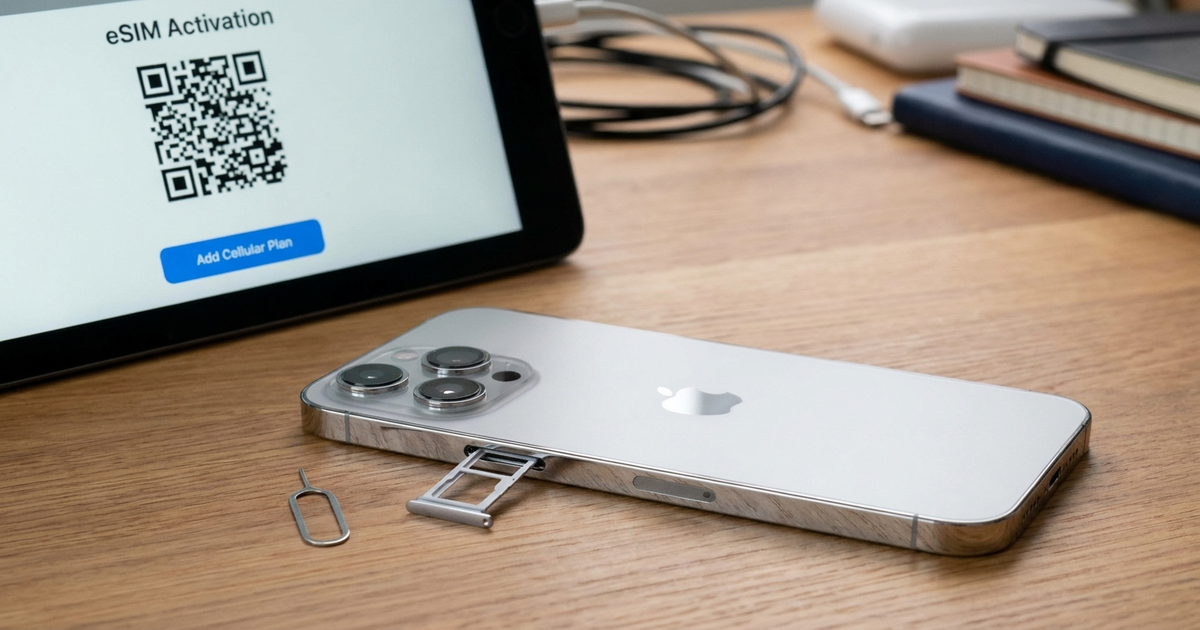
Sometimes. Since the iPhone 14, Apple has removed the SIM tray only on phones sold in certain countries. A U.S. iPhone 14, 15 or 16 has no slot. The same model bought in the U.K., Europe, Australia or most of Asia still has a nano-SIM tray plus eSIM. The country list grew to 12 regions with the iPhone 17 Pro and did not change for the iPhone 18 Pro. The iPhone Air is eSIM-only everywhere, and so is the iPhone Duo, according to MacRumors.
Chester Takau
Chester Takau is an independent reviewer of dual-SIM and eSIM technology, testing setups from the Pacific where connectivity choices really matter.
Which iPhones have no SIM slot, model by model?
This is the timeline, pulled from Apple's announcements and press coverage. "Tray" means a physical nano-SIM slot alongside eSIM.
| Model | No tray (eSIM-only) | Has a tray |
|---|---|---|
| iPhone 14 (Sept 2022) | U.S. only. First eSIM-only iPhone, with dual eSIM | Everywhere else |
| iPhone 15 and 16 | U.S. only | All models sold outside the U.S. |
| iPhone 17 / 17 Pro | 12 countries and regions (listed below) | Everywhere else |
| iPhone Air | Worldwide | None |
| iPhone 17e | Canada has no tray, per iPhone in Canada | Not covered by my sources outside Canada |
| iPhone 18 Pro / Pro Max (Sept 2026) | Same 12 countries and regions | Everywhere else. China models are physical SIM with eSIM now allowed |
| iPhone Duo | Worldwide, per MacRumors | None |
The 12 eSIM-only regions for the iPhone 18 Pro and Pro Max: the United States, Canada, Mexico, Guam, the U.S. Virgin Islands, Japan, Bahrain, Kuwait, Oman, Qatar, Saudi Arabia and the UAE. Per MacRumors, that matches the iPhone 17 Pro list.
How do I check whether my iPhone has a tray?
Look at the left or right edge for a small pinhole slot. If you can't tell, or you are buying used or gray-market, open Settings > General > About and read the model number. For the iPhone 18 Pro Max, MacRumors lists four versions:
- A3473 (U.S.): eSIM-only, with mmWave
- A3716 (Canada, Japan, Mexico, Middle East): eSIM-only, no mmWave
- A3717 (UK, Europe, most other countries): nano-SIM tray plus eSIM
- A3718 (China): physical SIM, eSIM activation now allowed
Other iPhone generations use different model numbers, so look them up on Apple's spec page for your model rather than guessing from this list.
Why did Apple drop the tray?
Apple gives two reasons. The first is security: a thief can't pull an eSIM out of a lost or stolen iPhone. The second is space. On the 18 Pro Max, the eSIM-only versions have a 5,567 mAh battery against 5,391 mAh for the tray versions, and Apple says the freed space adds about 2 hours of video playback on eSIM-only models. It also says over 500 carriers worldwide support eSIM.
That battery gap annoys some buyers in the U.K. and Europe, who get the smaller battery. There is also a trap in the EU: MacRumors notes that battery figures on EU regulatory labels cover the tray models only.
Will Europe lose the tray soon?
Not yet. Europe has been predicted to go eSIM-only for the iPhone 17 in 2025 and again for the iPhone 18 in February 2026, when a Greek site's report spread widely. The September launch proved it wrong. Some pages still repeat the rumor, so check the date on whatever you are reading.
Tech Tips walks through eSIM activation on a tray-less iPhone 18 Pro. I haven't verified the video's details, so treat it as a setup demo only.
What do I lose without a physical SIM?
Mostly flexibility. You can't pop your SIM into an Android or a backup phone. Cheap local prepaid SIMs abroad are often physical, and some travel eSIMs can't be moved to another phone. Launch coverage in 2022 warned that U.S. iPhone 14 models struggle where physical SIMs are required, naming China and Indonesia, and TechNode reported that U.S. models didn't work on China's major carriers. That advice is dated, and China's own iPhone 18 Pro models now accept eSIM, so check your destination carrier before you go.
If you plan to travel on an eSIM instead of a local physical SIM, compare the best Airalo alternatives before you go.
Can an eSIM-only iPhone still run two lines?
Yes. The iPhone 14 introduced dual eSIM, so two eSIMs can be active together. Apple allows several eSIMs to be stored, with up to eight reported, and a physical SIM from a carrier can be converted to eSIM. Once two lines are active, it helps to name your SIM cards for easy identification so you can tell the lines apart for calls and data.
What this article is based on
This is a research piece, not a hands-on test. I compiled it from Apple's announcements, MacRumors, TechCrunch, heise, and Apple Community and MacRumors forum threads, where buyers regularly ask whether they can add a physical SIM to a U.S. iPhone 14 (they can't) or why an iPhone 15 has no tray. The information gain here is a single model-by-region table plus a model-number lookup. Most pages cover one model or sell a travel eSIM.
Sources
- Apple Newsroom: iPhone 18 Pro and 18 Pro Max (Sept 9, 2026)
- MacRumors: iPhone 18 Pro is eSIM-only in these countries (Sept 9, 2026)
- MacRumors: four iPhone 18 Pro Max models (Sept 25, 2026)
- MacRumors: iPhone 18 Pro Max battery capacities (Sept 9, 2026)
- heise: iPhone 17 eSIM-only countries (2025)
- TechCrunch: iPhone 14 ditches the physical SIM in the U.S. (Sept 7, 2022)
- iPhone in Canada: iPhone 17e and the end of physical SIMs in Canada (Mar 2, 2026)
Updated November 2026.
Transparency note: This article was researched and written by Chester Takau with AI assistance for research gathering and drafting. All recommendations reflect the author's own editorial judgment.


