What Is an eSIM? How the Embedded SIM Actually Works
What Is an eSIM? How the Embedded SIM Actually Works
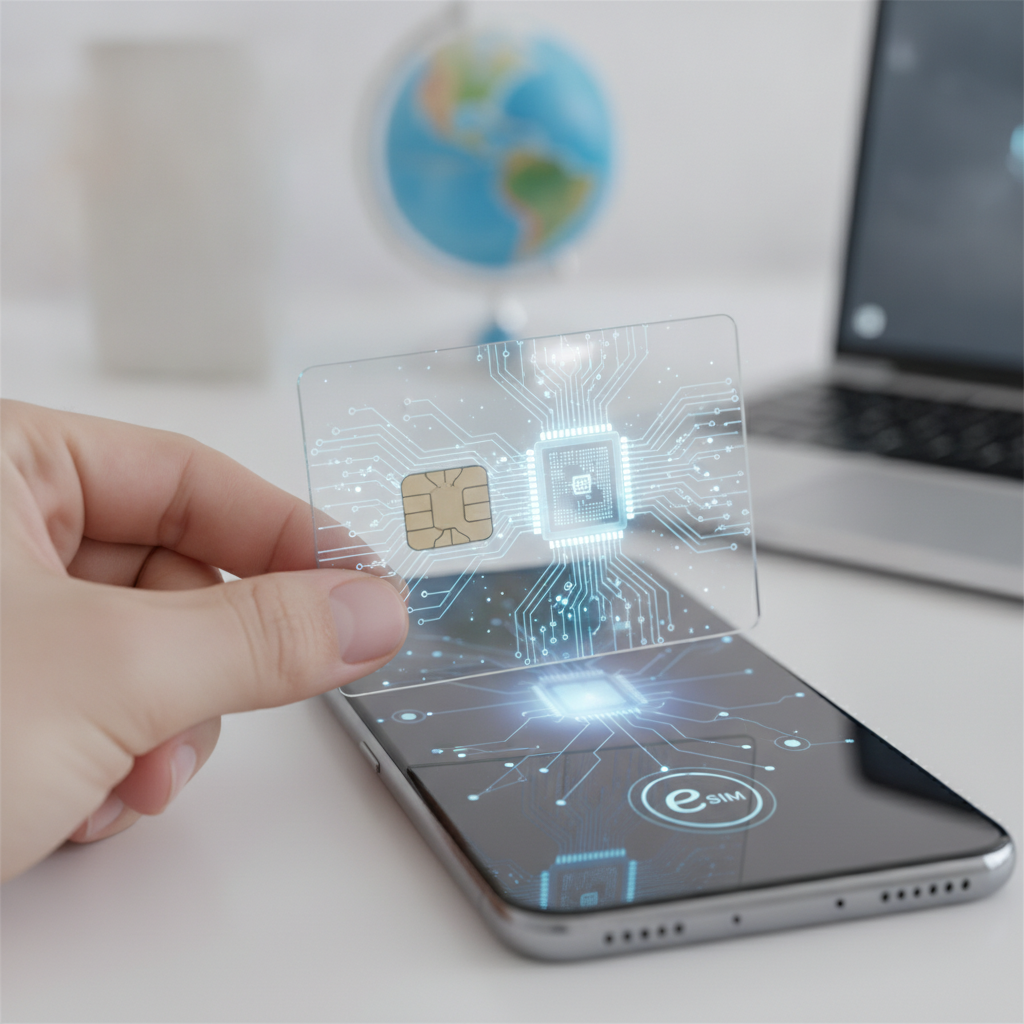
An eSIM (embedded SIM) is a small chip soldered permanently inside your phone that does the same job as a plastic SIM card — it stores the subscriber credentials that identify you to a mobile network. The difference is delivery: instead of inserting a card, you download a carrier profile over the internet, usually by scanning a QR code. One eSIM chip can hold several profiles, and you switch between them in your phone's settings rather than with a paperclip and a SIM tray.
The shift is already well underway. eSIM device connections grew from roughly 1.2 billion in 2025 toward a projected 1.5 billion in 2026 — about 30% growth in a single year, according to a January 2026 forecast from Telecom Reseller. Apple's decision to ship eSIM-only iPhones in the US since the iPhone 14 forced carriers worldwide to catch up, a ripple effect tracked in Cellesim's 2026 eSIM statistics roundup.
About the author: Chester Takau is an independent reviewer of dual-SIM and eSIM technology, testing setups from the Pacific where connectivity choices really matter. — DualSIMCardPhone
What an eSIM actually is
The "e" stands for embedded, and the technical name for the chip is eUICC — embedded Universal Integrated Circuit Card. It's a small, rewritable secure chip soldered onto the phone's motherboard during manufacturing, standardized by the GSMA, the industry body that owns the eSIM specification.
A traditional SIM card bundles two things together: the secure chip and the plastic carrier that holds your carrier's data. An eSIM keeps the chip and discards the plastic. Your carrier's subscription — the phone number, network keys and authentication data — arrives as a downloadable "profile." Profiles are delivered from a provisioning server (called an SM-DP+ address in the GSMA spec) and installed onto the chip, a process the industry calls remote SIM provisioning. Because the chip is rewritable, you can delete one carrier's profile and install another's without touching any hardware.
How is an eSIM different from a regular SIM card?
Functionally, both do the same job: prove to a network that you are a paying subscriber. Practically, they behave very differently. Most explainers stop at "there's no plastic card," but the differences that actually affect you are in activation, switching, travel and what happens when a phone is lost or replaced. This table maps those side by side from the GSMA specification and 2026 carrier documentation:
| Physical SIM | eSIM | |
|---|---|---|
| What it is | Removable plastic card holding a secure chip | Secure chip (eUICC) soldered to the motherboard |
| Activation | Insert the card | Download a profile via QR code, carrier app or manual code |
| Switching carriers | Wait for or collect a new card | Download a new profile — no shop visit or shipping |
| Plans on one device | One per card (two with a dual tray) | Store multiple profiles (8+ on iPhone); one or two active at once |
| Travel | Hunt for a local SIM shop on arrival | Buy and activate a travel plan before you land |
| If the phone is stolen | Thief can pop the card into another phone | No card to remove; moving the profile requires carrier verification |
| Moving to a new phone | Move the card across | Transfer or re-issue the profile through the carrier |
| Device support | Essentially universal | Most flagships since ~2018; patchy on budget and regional models |
How eSIM activation works
There are three ways a profile lands on the chip. The most common is a QR code from your carrier: you scan it, the phone contacts the carrier's provisioning server, downloads the profile and installs it — the whole thing takes a couple of minutes on Wi-Fi. Many carriers now skip the QR code entirely and push activation through their app or, on iPhone, directly during device setup. The third route is manual entry: you type in the server address and activation code yourself, which is the fallback when a QR code won't scan.
Two practical points trip people up. You need an internet connection (usually Wi-Fi) to download the profile, so activate before you're standing in an airport arrivals hall. And most QR codes are single-use or time-limited — once a profile is installed, that code is spent. For the full walkthrough on any device, see our guide on how to set up an eSIM on any phone, step by step.
If you prefer a visual explanation, this March 2026 video covers the eUICC chip, QR-code activation and multi-profile switching in plain terms:
Can I use dual SIM with one physical SIM and one eSIM at the same time?
Yes — this is how most dual-SIM phones are actually used in 2026. The arrangement is called Dual SIM Dual Standby (DSDS): both lines stay registered on their networks at once, and incoming calls and texts reach either number. In settings you pick which line handles mobile data, and which is the default for outgoing calls and SMS. You can flip those defaults any time, so a common setup is your home number on the physical SIM for calls and a cheap data eSIM for internet.
Which combinations a phone allows depends on the model, and this is where most coverage goes vague. The practical picture in 2026:
- iPhone 13 and later can run two eSIMs actively at once and store eight or more profiles — see Apple's official eSIM documentation and our walkthrough of iPhone eSIM setup for adding and switching plans.
- Google Pixel 7 and later support two active eSIM profiles as well.
- Samsung Galaxy S models vary by region and firmware. Threads on Samsung's own community forums describe SMS sending from the wrong line, 5G refusing to lock on the eSIM leg, and both lines cycling after updates — usually fixable, but worth knowing before you rely on it.
- Many budget and mid-range Android phones allow only one active eSIM at a time, paired with a physical SIM. Check the exact model and regional variant, not just the brand.
Running two lines does cost some battery — the modem maintains two network registrations — but in normal use the extra drain is modest, not the halving some forum posts claim.
Is a travel eSIM actually cheaper than roaming, or is it a scam?
The category is real and growing fast: the global travel eSIM market is valued at about $1.75 billion in 2026 and projected to reach $4.06 billion by 2035, with travel eSIMs now used on 41% of international trips from North America, per Signalink's July 2026 industry update. The products are typically data-only plans on local networks, bought online and activated by QR code before departure. For most travelers the maths beats carrier roaming day passes clearly, especially on trips longer than a few days.
The scam perception comes from the reseller layer, and it's not baseless. Many travel eSIM brands are resellers of the same underlying networks, and quality varies. Trustpilot reviews across travel eSIM providers show the split: plenty of smooth activations alongside reports of eSIMs that never activated, expired early, or came with unresponsive support. The protection is boring but effective — buy from providers with visible customer support, check the plan covers your specific country (not just the region), and activate while you still have home Wi-Fi so you can troubleshoot.
Security: theft, SIM-swap fraud and the control debate
eSIM changes the theft equation mechanically. With a physical SIM, a thief can move your number to another phone in seconds by popping the tray. With an eSIM there's no card to remove, and transferring a profile to a new device requires passing the carrier's verification — the same barrier that makes SIM-swap fraud harder to pull off. Profiles are also delivered and stored under the GSMA's security specifications, with the credentials encrypted on the chip.
The counterargument is about control, and it has a vocal constituency. In a long GSMArena comment thread on eSIM-only iPhones, critics argue that a removable card is the ultimate kill switch: you can physically pull your identity out of a device you no longer trust, and moving service between phones never requires a carrier's permission. Both things are true. eSIM removes a physical attack surface while making you more dependent on carrier processes for transfers and re-activation. Which trade-off suits you depends on whether you worry more about someone stealing your SIM or about your carrier being slow to reissue one.
Where eSIM stands in 2026
Three developments are pushing eSIM past the early-adopter phase this year. The GSMA's SGP.32 standard, launched in 2025 and gaining traction through 2026, extends remote provisioning to IoT devices at scale — bulk activation and provider switching without anyone touching hardware, as Telecoms.com's 2026 outlook describes. In the EU, new device cybersecurity requirements are nudging eSIM toward default status, and new transfer tools make it easier to move your number and profile between phones, even across operating systems, under the 2026 EU roaming and portability rules. And in the US, satellite connectivity is arriving as an eSIM profile layer — T-Satellite lets customers of AT&T, Verizon and other carriers add satellite coverage without switching providers.
Frequently asked questions
Does switching to eSIM mean I lose my phone number if I change phones?
No. Your number lives in your carrier account, not in the chip. When you change phones you either transfer the eSIM profile during setup (iPhone-to-iPhone and an increasing number of Android paths support this) or ask the carrier to re-issue it, usually as a fresh QR code. Number portability rules, especially in the EU, guarantee you keep the number when switching carriers too.
How many eSIMs can one phone store, and how many can be active at once?
Storage and active use are different limits. iPhones store eight or more profiles; many Android phones store five or more. Active use is tighter: recent iPhones and Pixels allow two active eSIMs simultaneously, while many other Android phones allow just one active eSIM alongside a physical SIM. Stored profiles you aren't using sit dormant until you toggle one on.
What happens to my eSIM if I factory reset or sell my phone?
On both iPhone and Android, a factory reset asks whether to keep or erase eSIM profiles. Keep them and they survive the reset; erase them and you'll need the carrier to re-issue each profile — the original QR code usually won't work twice. Before selling a phone, erase the profiles: the buyer gets a clean device and your subscription stays with your carrier account.
Why did my eSIM stop working or show "no service" after an update or airplane-mode toggle?
This is a recurring complaint in Samsung and Android forums, and it's usually a software state issue rather than a dead eSIM. The fixes that most often work, in order: toggle the eSIM line off and on in settings, restart the phone, re-select the line for data, then reset network settings. If the profile itself is corrupted, the carrier can push a fresh one.
Can an eSIM be hacked or remotely disabled?
The profile is protected by the GSMA's provisioning security, and there's no evidence eSIM gives attackers an extra way in compared with a physical SIM — if anything, removing the stealable card closes one. A carrier can deactivate your service, but that's equally true of a plastic SIM; the difference is you can't physically remove an eSIM from the equation.
If I travel to a country where eSIM isn't supported, am I stuck?
Not stuck, but you need to plan. Carrier eSIM support still varies by country, which is why some travelers argue physical SIM remains the safer fallback in regions with inconsistent support — a debate Cybernews covers from both sides. On an eSIM-only phone, check that your carrier or a travel eSIM provider covers the destination before you fly; on a phone with a tray, a local physical SIM remains the universal backup.
Sources
- GSMA — owner of the eSIM/eUICC and SGP.32 standards
- Apple Support — official eSIM setup and dual-eSIM documentation
- Telecom Reseller — eSIM connection forecast, January 2026
- Signalink — global travel eSIM market update, July 2026
- Telecoms.com — SGP.32 and IoT provisioning trends, 2026
- MyBestSIM — EU roaming and portability rules, 2026
- Cellesim — eSIM adoption statistics, 2026
- T-Mobile — carrier consumer explainer on eSIM
Updated September 2026.
Transparency note: This article was researched and written by Chester Takau with AI assistance for research gathering and drafting. All recommendations reflect the author's own editorial judgment.


