Prepaid vs Postpaid for Frequent Travelers: The Real Cost Breakdown
Prepaid vs Postpaid for Frequent Travelers: The Real Cost Breakdown
By Chester Takau · August 2026
Direct answer
If you're abroad more than a few weeks a year, a prepaid travel eSIM for data beats postpaid roaming on cost almost every time — carrier day-passes run $10-$20/day versus $3-$5/day for prepaid eSIM data. But don't cancel your postpaid line to get there. Downgrade it to a cheap plan that just holds your number, and run a prepaid eSIM alongside it for data.
The exception: short trips (under a week) to one country where your carrier sells a flat-rate day pass — juggling a prepaid eSIM install isn't worth the savings.
Chester Takau
Chester Takau is an independent reviewer of dual-SIM and eSIM technology, testing setups from the Pacific where connectivity choices really matter.
This isn't really a prepaid-vs-postpaid question — it's a "what does each line need to do" question. Postpaid and prepaid aren't competing for the same job on a frequent traveler's phone. One holds your number and your 2FA texts. The other moves your data at a price that doesn't punish you for crossing a border. Treat them as one job each, and the whole decision gets simpler.
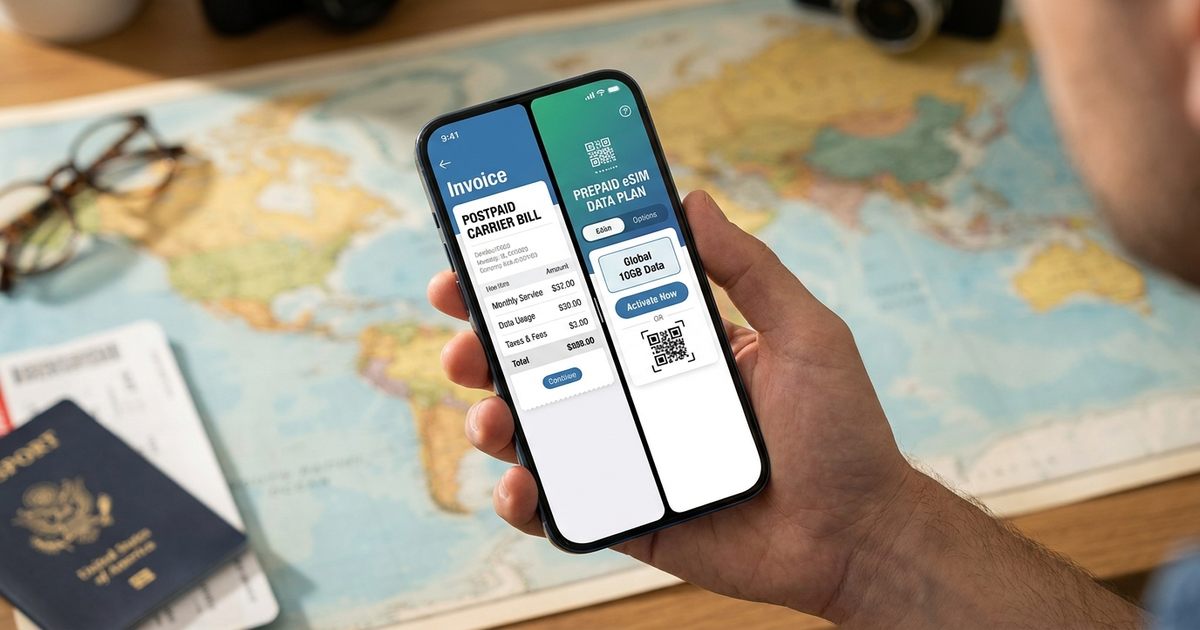
Prepaid vs Postpaid Roaming: Side-by-Side
| Factor | Postpaid (home carrier roaming) | Prepaid (travel eSIM) |
|---|---|---|
| Typical daily data cost | $10-$12/day (US carriers), £2-£5/day (UK), CAD $12-$20/day (Canada) | $3-$5/day equivalent on a 7-14 day data bundle |
| Bill shock risk | Real — AT&T's published pay-per-use rate is $2.05/MB if a pass lapses, close to $2,099 for 1GB | None — fixed price paid upfront, data just stops at the cap |
| Setup effort per trip | None — it just works when you land | Install a QR code eSIM before or on arrival, per region |
| Keeps your home number active | Yes, by definition | Not on its own — most travel eSIMs are data-only |
| EU-to-EU travel | Free at domestic rates for EU carriers under "Roam Like at Home" (extended through 2032) | Rarely cheaper than an EU postpaid plan for EU-only trips |
| Best for | Short single-country trips, EU residents in the EU, business expensing | Multi-country trips, 5+ days abroad, anyone traveling monthly |
The Break-Even: How Often Do You Need to Travel Before Prepaid Wins?
Run the numbers instead of guessing. A US carrier's $10/day pass over a 10-day trip is $100. A prepaid eSIM covering the same trip with a 10GB regional bundle typically runs $25-$40. That gap holds for almost any trip longer than three or four days — the day-pass model only wins on very short trips where the eSIM's per-trip setup isn't worth it, or in the EU where your postpaid plan already includes free roaming. If you travel abroad more than roughly 20-25 days a year, the prepaid side saves real money across the year, not just per trip.
Postpaid's honest case
Most coverage of this topic is written by eSIM sellers, so it skews hard toward "cancel postpaid roaming." That's not always right. If you're on a plan like T-Mobile's that bundles free international roaming, or you're expensing the trip through a business account, postpaid roaming can beat juggling a new eSIM install in every country. The prepaid case gets weaker the shorter and more single-country your trips are.
Prepaid vs Postpaid Cost Calculator
Enter your trip length and home carrier's day-pass rate to see which option actually costs less.
Estimates only, based on typical 2026 published rates in this article. Check your own carrier's current day-pass price before deciding.
Should I Keep My Postpaid Line Active While Abroad, or Cancel It?
Keep it, but shrink it. The recurring mistake frequent travelers make is treating this as all-or-nothing — either pay full postpaid price every month or cancel and lose the number. Neither is necessary. Downgrade the postpaid plan to its cheapest tier (or move to a low-cost prepaid plan on the same carrier) so it just holds your number and receives calls and texts, then let a prepaid eSIM carry the actual data load on every trip. This is the dual-SIM mechanic underneath most of the "hybrid" advice floating around: one line for identity, one line for data, and neither one has to be expensive to do its job. If you're new to how two SIM identities live on one phone without conflicting, the dual SIM basics guide covers the mechanics.
The 2FA and Banking-Text Trap
This is the part that gets skipped in most prepaid-vs-postpaid comparisons, and it's the reason not to fully cancel a postpaid line. Bank one-time codes, account recovery texts, and app 2FA are tied to your number, not your data connection. A pure prepaid travel eSIM is usually data-only and was never assigned a number capable of receiving those texts. If you drop your postpaid line entirely, you can lock yourself out of your own bank account mid-trip. Keeping a minimal postpaid or low-tier prepaid line active — even one that never leaves airplane-toggle mode except to check messages — is what keeps that channel open.
What's the Cheapest Way to Park a Number for Months at a Time?
If you're gone for extended stretches, a full postpaid bill for a line you're not using is the actual waste, not the roaming. Most major US prepaid carriers let you keep a number alive by paying a small refill every 30-60 days rather than a monthly postpaid rate — Verizon's own prepaid line is the most commonly cited example for this. The tradeoff is manual: you have to remember to top it up, and letting it lapse means losing the number outright. For most frequent travelers this is a better fit than full postpaid, precisely because the line's only job during travel months is receiving calls and 2FA texts, not carrying data.
Setting Up the Dual-SIM Split
In practice this is a phone settings task, not a shopping task. Your postpaid or low-tier prepaid SIM stays installed and set as default for calls and texts, with its data roaming switched off so it can't rack up charges by accident. A prepaid travel eSIM goes in the second slot and becomes the default for cellular data — that's the line actually paying for maps, messaging apps, and browsing. The mechanics of the eSIM side, including how the embedded profile differs from a physical card, are covered in the eSIM explainer if you haven't set one up before. Once installed, most travel eSIM data bundles can be topped up for a second trip without reinstalling the profile — the eSIM recharge guide walks through adding data to an existing profile instead of buying a new one each time.
This comparison video tests carrier roaming, a local SIM, and a travel eSIM against each other directly, which is a useful gut-check on the numbers above before you commit to a setup:
Note: this video is sponsored by an eSIM provider, so weigh its specific product recommendation accordingly — the underlying roaming-vs-eSIM cost comparison is still useful.
Quick reference
- Traveling 5+ days, multiple countries → prepaid eSIM for data, wins on cost almost every time
- Short single-country trip → a carrier day-pass can be simpler and close enough in price
- EU resident traveling within the EU → postpaid roaming is free under Roam Like at Home, skip the eSIM
- Gone 6+ months → downgrade to a prepaid line paid every 30-60 days rather than a full postpaid bill
- Never do this → cancel your only line and lose the number your bank sends 2FA codes to
Sources: Simology, international roaming costs 2026 · Cellesim, roaming charges by carrier and country 2026 · Android Authority, ditching a US carrier while traveling · Apple Support, using eSIM while traveling internationally · AARP, why to use eSIMs when traveling internationally
Updated August 2026.
Transparency note: This article was researched and written by Chester Takau with AI assistance for research gathering and drafting. All recommendations reflect the author's own editorial judgment.


