Does a Travel eSIM Work on a Cruise Ship at Sea? Only Maritime Plans Do
Does a Travel eSIM Work on a Cruise Ship at Sea? Only Maritime Plans Do
By Chester Takau · November 2026
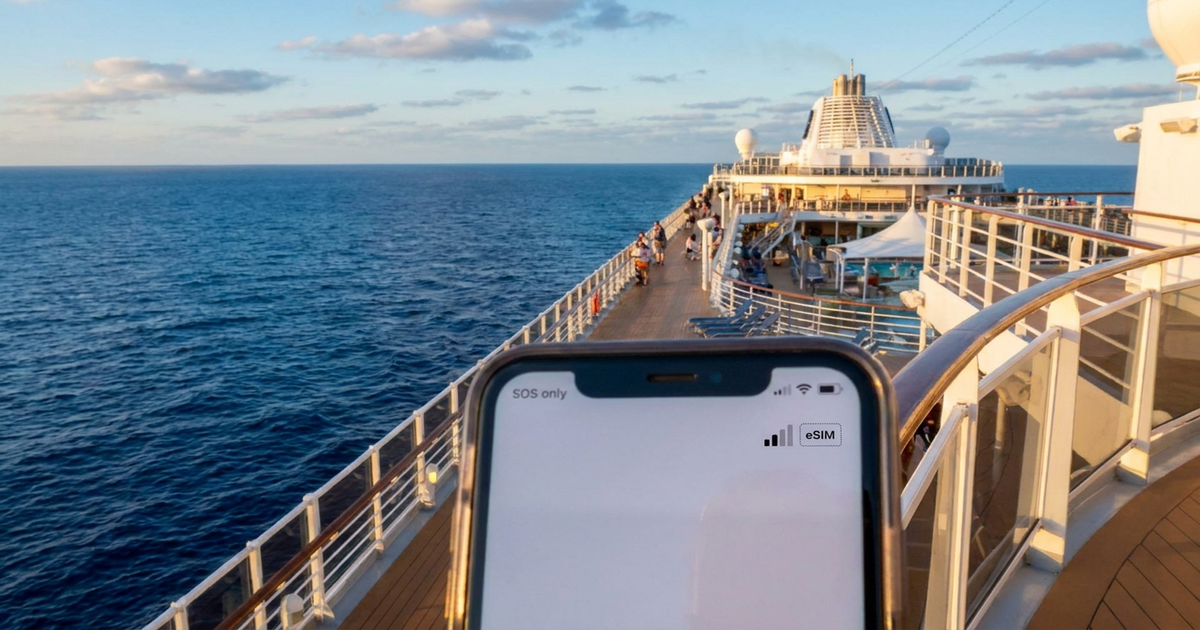
It depends on which kind of eSIM you bought. A normal land-based travel eSIM works in port and near the coast, then loses signal once the ship is roughly 12 nautical miles out, because the ship switches from shore networks to its own satellite-fed system (Kotaku, June 2026). A maritime-enabled eSIM, such as Red Bull MOBILE Maritime, GigSky, Saily's cruise plans, OneRoam or Maya's Global + Cruise option, is built to attach to that onboard network, so it keeps working at sea. Even then, coverage depends on the specific ship.
Chester Takau
Chester Takau is an independent reviewer of dual-SIM and eSIM technology, testing setups from the Pacific where connectivity choices really matter.
The three connection states, by distance from land
| Where the ship is | Land-only eSIM (Airalo, Holafly type) | Maritime-enabled eSIM |
|---|---|---|
| In port or close to shore | Works on the local land network | Works, usually on land networks too |
| Leaving port, land signal fading | Signal drops; phone may search or show "No Service" | Hands over to the ship's network |
| Beyond about 12 nautical miles | Nothing, or a ship network your plan doesn't cover (it may appear as network "901") | Works if the ship's maritime operator is one your plan supports |
Why do some eSIMs work at sea and others don't?
Ships carry a small cellular network of their own, fed by satellite. Two operators dominate: Telenor Maritime and WMS/Cellular at Sea. Telenor's April 2024 release for Red Bull MOBILE Maritime says the eSIM works on 150+ cruise ships and ferries, with 250 MB for €5 or 1 GB for €15. The same release makes the catch clear: the ship decides which maritime network you get, so coverage follows the vessel, not the cruise line. OneRoam, launched 30 March 2026, runs on Cellular at Sea's network and claims 210+ ships.
Saily added cruise plans on 25 June 2026 covering 200+ ships across Royal Caribbean Group, Carnival Corp., NCL Holdings, MSC, Disney, Virgin Voyages, P&O and Cunard, from $16.99 (500 MB, 1 day) to $69.99 (5 GB, 30 days). Maya's May 2026 platform change added a "Global + Cruise" option; TechRadar's review notes that third-party pages disagree on its prices and on how "unlimited" it really is.
Will I get a huge bill if my phone joins the ship's network?
It can. If your home SIM has cellular data and roaming on, the phone may join the ship's network at maritime roaming rates, which are far above normal roaming. The standard advice, repeated by AvoidRoaming, is airplane mode with Wi-Fi switched on. On a dual-SIM phone the safe version is to turn off roaming on the home line, set your cruise eSIM (or nothing) as the data line, and switch off automatic network selection so the phone doesn't hop onto a ship network you didn't choose. Menu names vary by phone, so confirm them at home, not on deck.
Is it faster or cheaper than ship Wi-Fi?
Cost is the real argument. Cruise lines raised Wi-Fi prices through late 2025 and 2026 while rolling out Starlink, which has made ship Wi-Fi fast. One vendor page lists Norwegian at $29.99 per device per day (Voyage pass) and $39.99 (Streaming pass). A maritime eSIM on a 7-night cruise with 4 sea days could cost less than a single day of that, depending on the plan, though the vendor figure is not a price from NCL itself.
Speed is a trade. One affiliate reviewer on MSC Bellissima, using GigSky's 10 GB Cruise + Port plan (about $100), measured around 8 Mbps down and 4 Mbps up at sea with 5 to 10 short drops a day, "slower but steady at sea, fast and full-speed in port." That reviewer received GigSky credit and uses affiliate links. Passenger reports are mixed: on a June 2026 Mumsnet thread, Red Bull MOBILE Maritime worked for some, GigSky worked for some but was "barely usable" for one person and needed a refund for another, and Airalo was recommended for land use only. Treat "unlimited" claims with care too: eSIMDB lists Maya at 5 GB a day at full speed, then 3 Mbps.
Soul Compass compares cruise eSIMs with ship Wi-Fi. I could not check the transcript or upload date, so treat it as one viewpoint.
Check-before-sailing list
- Find your exact ship on the eSIM seller's coverage list. Cruise line alone is not enough.
- Install the eSIM at home on Wi-Fi, but don't activate the data line until you need it, following the seller's instructions.
- Turn roaming off on your home line and set automatic network selection to manual.
- Size the plan: work out how much data you need per day, and check any daily fair-use cap.
- Keep a land eSIM for port days if your maritime plan is pricey on land. If you are still choosing one, look at Airalo alternatives for land use.
- Save the seller's support contact and refund terms before you lose signal.
What this article is based on
This is a research piece, not a hands-on test; I have not tested these plans at sea. It draws on vendor and operator announcements, press coverage and passenger reports. Reddit was not accessible to me. The information gain is one table that splits eSIMs by connection state and distance from land, plus a pre-sailing checklist built around the dual-SIM data-line settings most cruise guides skip.
Sources
- Kotaku: Saily eSIM plans now cover cruise ships (June 2026)
- Telenor Maritime: Red Bull MOBILE eSIM (April 2024)
- GlobeNewswire: OneRoam launch (March 30, 2026)
- TechRadar: Maya Mobile eSIM review (2026)
- eSIMDB: Maya Mobile
- Mumsnet: eSIM for sea days only (June 2026)
- Bucket List Guides: GigSky on MSC Bellissima (affiliate)
- EarthSIMs: Norwegian Cruise Line Wi-Fi prices (August 2026, vendor page)
- AOL: cruise Wi-Fi prices rising
- Cruise Critic: reactions to Wi-Fi price spikes
- Container News: cruise connectivity at sea
- AvoidRoaming: cruise ship roaming charges
Updated November 2026.
Transparency note: This article was researched and written by Chester Takau with AI assistance for research gathering and drafting. All recommendations reflect the author's own editorial judgment.


